Saturday, 21 March 2009

SYW Regimental Variant

Given the small scale of the Hetzenberg Battle I was asked to fight recently I decided to run it at roughly a double scale to my normal SYW games, i.e. 48 figure units rather than 24. I had debated using either the rules from "Charge" or "The War Game" directly, but I decided on a variant of my AWI/SYW rules, but still influenced by them.

An infantry regiment is made up of 4 companies each of 2 infantry bases (standard AWI unit), the cavalry has 3 squadrons each of 2 bases and an artillery battery has two guns. The infantry regiment may have up to one grenadier company and/or one light infantry company. To cover the larger size of most Hussar regiments, consider the unit represents a battalion (half a regiment) or add an extra squadron. Dragoon regiments may add a squadron of light dragoons where appropriate. Each regiment will need a Colonel (I use my existing brigadiers for this).


Unit cohesion is represented by all the companies being within 6" of another or the Colonel unless performing a compulsory morale action, rout, etc. Cavalry and artillery can be up to 12" apart. Colonels wherever possible should be with a nominated company/squadron.

Morale changes (morale effect firing or being charged test)
Colonel with unit +1
More senior officer +2

Morale changes (shaken)
Any other sub unit of the regiment routing last move -1

I have been testing an alternative being charged test but I'll cover this in a separate variant.

Loss for regimental colours if the subunit carrying them routs as a result of an enemy charge roll 2d6 a result of 11 or 12 means the colour was lost. If the rout was from melee a roll of 10 or higher results in the colour being lost. Optional effect of the loss of the colour roll 1d6 3 or less -1 on any shaken morale tests; 4 or 5; no effect 6 +1 on any shaken morale tests.
If a regiment remains stationary without firing or suffering any casualties then the Colonel may reallocate strength points between the sub-units, provided none exceed their original value. This allows the disbanding of a weak sub-unit in order to strengthen the remainder.
-------------------------------------------------------------------------------------------
Other options:
  • Forcing the companies to adopt their correct positions by seniority - having had one infantry regiment in the Hetzenberg game get out of order, it was quite confusing and I guess the difficulties of command and control in this situation was why the ordering was used a lot despite the apparent effort involved..
  • Square can only be formed by regiment

Monday, 2 February 2009

French Revolution variant

I'm going to use the AWI rules with my French and Austrian forces and initially I'll use the rules fairly straight, but I'm sure in time they will change.

Firstly I want to represent the faster French manoeuvring, so I will incorporate the go-for-it rule from Bloodbowl. Once movement is completed the French player can attempt to move one unit per general an extra 3" if infantry or 6" if cavalry.  on a roll of 4+ they will succeed.

Commanders will be able to "inspire" units this will directly effect the units basic morale when under fire, etc.  I will probably give commanders a separate inspiration value to reflect this.  When it is applied the commander in positioned with the unit, but at the front/side, when attached normally they will go to the rear.  Hopefully this will reflect actions such as the bridge at Arcole.  The downside is that the same "inspiration" is added to any risk to general roll thus increasing the chance of injury!

Permitted formations will now include a battalion square (2 bases back to back) and a regimental square (4 bases in a block with one base pointing in each direction), either taking a full move to form

Austrian units my be "stubborn" so that if they receive a rout result from a shaken test, it may be converted to a retire a full move shaken instead on a roll of 4+.

Please use the comments to suggest further ideas
 

Tuesday, 18 November 2008

AWI Terrain

Over a number of years I have built some specific terrain for the rules so for those who have expressed an interest here they are.
Firstly a modular range of fortifications. The original items were supplied in resin by Marbeth (I think) and the straight run of gabions had 11 gabions in it. To fit with my 45mm base sizes I cut of the end gabion to make a double length (rear) and then in half to provide a single length (front). I then used a pair of spare gabions to create a gun embrasure with matchstick timbers on the inside and the "earth" built up from plastic padding car repair kit with kitty litter mixed in to give bulk and texture.
Right angle bends were made with 6 gabion lengths using the filler to round off the ends

The buildings are constructed to a standard size of 50mm by 100mm on a 60mm by 120mm base. This size allows a full unit of infantry to drop neatly into the building. If it wasn't for the flag then the roof would fit back on again. I have one double sized building, which will hold two units and is made in the style of a colonial mansion.

The basic construction for most small buildings was a thin card template, glued onto a MDF base. Door and window surrounds were added from matchsticks A chimney was added from balsa and textured with tetrion. Then strips of thin card were glued onto the structure overlapped to give a clapboard effect. The roofs were made similarly with card shingles/tiles. The barn containing the figures was made out of "Wills" wooden panel plasticard. The mansion is more substantial and built out of foamcore with commercial window frames.

Will

Tuesday, 4 November 2008

Long Island Game - Eye Candy

Lots of nice pictures of the Long Island game involving Giles Allison...... link

Looks and sounded like great fun

Will

Friday, 17 October 2008

Bemis Heights (4) - Play Test

It's been a while since I wrote the scenario and last night we played it down at the Club. Paul took the British And I took the Americans. I found a few minor glitches and I'm now clear about the relative victory conditions so I'll update the relevant sections over the next day or so.

Commentary

The Britsh formed up to try and observe the America positions blocking the road to Albany. All was quiet for a while (no American units appeared on move 1) Then Poor's brigade appeared in the trees on the British left, while Morgans men moved through the woodland on the British right. Poor's brigade immediately suffered from the opening rounds from the British cannons, the result from this and subsequent rounds of fire meant that the brigade didn't emerge from the wood line until later in the game. Then over on the right Morgans men appeared at the wood edge but Dearborns came under fire from the cannon attached to the British light infantry. The rifles began to snipe at the British lights in return but the action stalled on this flank as well. Learned's brigade emerged from the trees to attack the centre of the British line but failed to make any headway against the solid German line.

When Ten Broek's militia arrived down the road the British were quite confident and commenced a steady withdrawal back towards their lines. (The British were not permitted to withdraw until the militia arrived).

Pressure was then built up on the British left and centre with the American weight of numbers beginning to tell. It culminated in Poor's brigade attacking from a flanking position and eventually starting the roll up of the British line from the left, although Acland and his grenadiers did a sterling job in holding them up. A wider turning move by the 1st Conn Militia suffered badly by drifting into the firing arc of all the guns in the Breymann and Balcarres redoubts.

On the British right Fraser conducted a steady withdrawal, the lights exacting a toll on Morgans rifles when they rashly charged into close combat.

Time was called after move 13 and on balance the game was progressing reasonably close to history. The Grenadiers did better than reality, but they didn't try charging the rebels. The guns were quite influential, perhaps explaining why they were taken on the reconnaissance. But they would mostly have been lost as actually happened so a mixed blessing? Morgans brigade was less effective than anticipated. The guns kept Dearborns pinned down so the rifles didn't have the numbers to drive off the British Light Infantry on their own. In retrospect as the American player I should have sent Morgans further round the British flank before emerging from the woods, and a similar action with Poor's brigade on the other flank would have been equally beneficial.

Overall a good game.

Further Analysis

Looking at the status of the units after the game, the British had only lost 17sp out of the 50sp in their forward line, but the losses were heaviest in the Grenadiers 4sp and across the artillery 9sp. The Americans had suffered far worse with 47sp lost, Poor's brigade had lost 50% (17sp out of 35) and Learned's 70% (14 out of 20) both showing the effect of the artillery fire. Morgan's losses of 40% (6 out of 15) reflected the results of trying to melee with the British light infantry.

Sunday, 21 September 2008

Gloucester Point break-out 1781

Work in progress - comments please

A nice what-if game. On the night of 16-17th October 1781. Cornwallis attempted to move his force across from Yorktown across to Gloucester Point to break out of the siege. Unfortunately the weather deteriorated and the rest is history. But what if the operation went ahead? The British have to break out within a time limit before the main American/French army could react and block their escape route.

British Forces

In Gloucester Point
Hessian Von Bose 1x 5sp
British Legion (Dragoons) 2 x 5sp
Queens Rangers (LI) 1 x 6sp
Artillery (6/12pdrs) 20 guns in 3 fixed batteries?

1st Wave arrives move 2
LI Abercrombie (LI) 4 x 5sp
Guards O'Hara 2 x 5sp

2nd Wave arrives move 4
Yorke 17th/23rd/33rd/71st Foot 4 x 4sp

3rd Wave arrives move 6
Dundas
Erbprinz 2 x 4sp
43rd/80th Foot 2 x 6sp
NC Volunteers 1 x 2sp

French/American

Weedon - Virginia Militia 6 x 5sp (Mercers unit is veteran militia)
Dabney State Legion 1 x 4sp

Lazuns Legion
Infantry 1 x 5sp
Cavalry 2 x 5sp
Guns?

Choisey
French Marines 4 x 4sp
Guns?

Deployment, etc.

I'm trying to find details of the terrain outside of Gloucester Point. Certainly to the east is the "Cedar" swamp blocking movement in that direction

Wednesday, 3 September 2008

Revolutionary Route

Just discovered a very nice collection of pictures by the New England historical artist David R Wagner covering the French forces under Rochambeau in the Americas. Nice ideas for vignettes, etc.

http://www.davidrwagner.com/revolutionaryrouteseries.htm

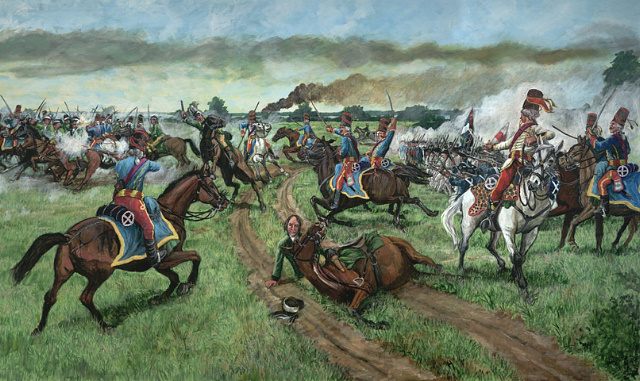
Just a taster with Lauzun's legion in combat against Tarlton